CLAT Prep & College Life: Balancing Both Without Stress
- kajal lawprep
- Oct 8, 2025
- 6 min read

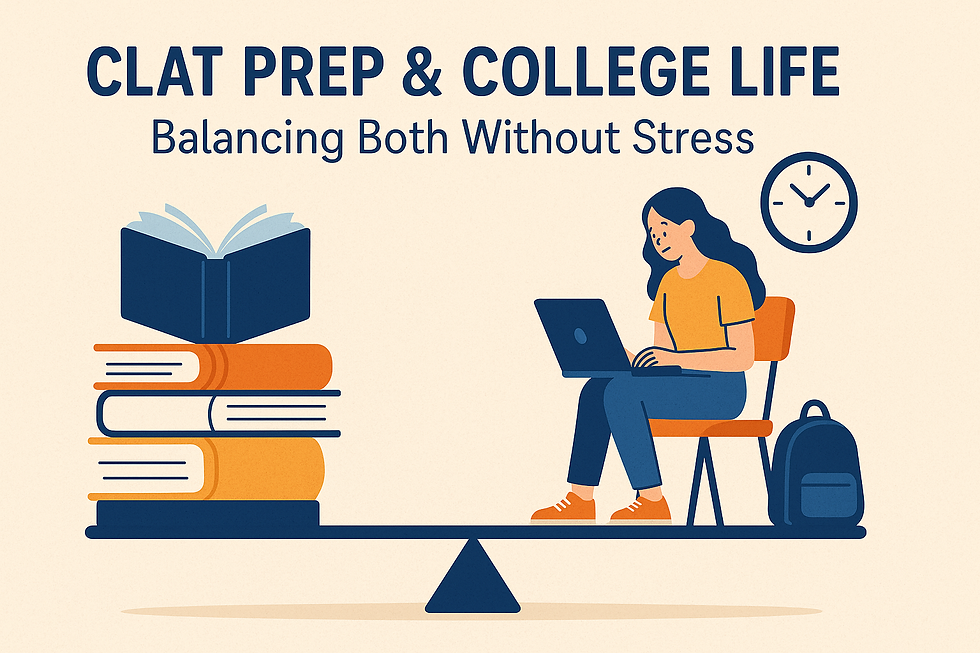
Preparing for CLAT while managing college life feels like walking on a tightrope — one wrong step, and you could lose balance. Between classes, assignments, friends, and the endless prep for your dream law school, it’s easy to feel overwhelmed. But the truth is, many students successfully juggle both — not because they study all day, but because they study smartly and manage their time with purpose.
This blog breaks down how you can balance college and CLAT prep without losing your sanity, using practical strategies, time-tested habits, and real-life insights from students who’ve done it right.
Understanding the Dual Challenge
Balancing college and exam preparation is not just about managing time — it’s about managing energy and focus. College brings its own challenges: lectures, internal exams, projects, and social life. CLAT, on the other hand, demands consistent practice, conceptual clarity, and a sharp mind for logical reasoning and current affairs.
The first step is acceptance — understanding that you can’t give 100% to everything every day. Some days, college will demand more time. Other days, CLAT preparation will take the spotlight. And that’s completely fine. The goal isn’t perfection — it’s consistency.
Step 1: Audit Your Current Schedule
Before jumping into any strategy, take a week to observe your current routine. Write down how you spend your time from morning to night — classes, commuting, social breaks, meals, and screen time.
You’ll probably notice two things:
A lot of unintentional time drain (scrolling, chatting, random YouTube).
Unused time pockets — short breaks or gaps between classes that could be productive.
These insights will help you create a plan that fits your actual lifestyle instead of an unrealistic ideal.
Example:If you commute 40 minutes daily, that’s 80 minutes a day. Listening to news analysis or revising vocabulary during travel can turn that into powerful prep time.
Step 2: Create a Flexible Weekly Plan
A rigid timetable often fails because college schedules keep changing. Instead, create a weekly goal-based plan.
Here’s how you can structure it:
Daily Targets: Reading comprehension, reasoning puzzles, or GK updates.
Weekly Targets: Mock tests, sectional tests, and current affairs revisions.
Monthly Targets: Reviewing weak areas and updating short notes.
The idea is to focus on progress, not perfection. Even if you study for just 2–3 focused hours a day, it adds up over months.
Tip: Keep Sunday as a light day — revise, watch a law-related documentary, or just rest. Your mind needs recovery too.
Step 3: Morning Power Hours
If college eats up most of your day, mornings are your best ally. Early hours are quiet, distraction-free, and perfect for deep study.
Try waking up just an hour earlier — not to cram, but to focus on one crucial area.
Morning study ideas:
Solve one Reading Comprehension passage and analyze every mistake.
Revise 20–30 GK headlines.
Practice a few logical reasoning questions.
Even one strong, undisturbed hour every morning gives you momentum that lasts through the day.
Step 4: Use College Resources Smartly
Your college environment can actually help your CLAT journey if you use it strategically.
Study Groups: Form small peer groups (even if they aren’t CLAT aspirants). Group study helps with consistency and accountability.
College Library: Ideal for focused study between lectures. Many libraries have online access to newspapers and journals — great for reading practice.
English and GK Through Classes: Use your college assignments and readings to indirectly prepare for CLAT — essays, debates, or presentations help build your comprehension and general knowledge naturally.
Know more about: Past 5 Years of CLAT Papers: Patterns You Can’t Ignore
Step 5: Prioritize Quality Over Quantity
A common mistake students make is equating long study hours with progress. In reality, 90 minutes of focused, distraction-free study often beats four hours of half-hearted reading.
To improve focus:
Keep your phone in another room or use focus apps like Forest or Focus To-Do.
Break study blocks into 45-minute chunks with 10-minute breaks.
Use the Pomodoro Technique when energy levels are low.
Step 6: Treat Mocks as Mini Exams
Mocks are the heart of CLAT preparation — they reveal where you truly stand. But with college exams and activities, it’s tempting to skip them. Don’t.
Here’s how to manage them:
Take one full mock every two weeks, and increase frequency closer to the exam.
Analyze your mistakes the next day instead of rushing into the next test.
Maintain a mistake notebook for recurring patterns — like wrong assumptions in logical reasoning or weak vocabulary.
Example:If you scored low in the current affairs section, don’t panic. Revisit that month’s news summaries and revise. Progress comes through small course corrections, not panic-driven overhauls.
Step 7: Build a Sustainable GK Routine
GK can be tricky — it’s vast and ever-changing. The secret is consistency, not cramming.
A 15-minute daily routine works wonders:
Read the newspaper’s editorial section for comprehension.
Use monthly GK compilations to summarize key events.
Discuss current issues with friends — it helps with memory retention.
If you’re preparing for CLAT 2026, start early by making GK part of your daily lifestyle. Read, revise, and relate — that’s the mantra.
Step 8: Learn to Say “No”
One of the toughest parts of balancing college and prep is learning when to step back. You don’t need to attend every fest or join every club.
It’s okay to skip a few outings or late-night events if your next morning is dedicated to mock analysis. Balance doesn’t mean doing everything — it means choosing wisely.
Remember, discipline isn’t about saying “no” to fun — it’s about saying “yes” to your goals more often.
Step 9: Avoid These Common Mistakes
Balancing both college and CLAT is hard enough — don’t make it harder by repeating avoidable mistakes.
1. Starting Too Late
Many students wait until the last six months. By then, college exams pile up, and stress doubles. Start small, but start early.
2. Neglecting Revision
You don’t need to learn something new daily. Spend one day a week revising — it’s what converts knowledge into long-term memory.
3. Overdependence on Coaching
Coaching is a guide, not a substitute for self-study. Make your own short notes and review them regularly.
4. Burnout from Overcommitment
Studying 10 hours on weekends and zero on weekdays is a red flag. Balance matters more than intensity.
5. Ignoring Health
No amount of preparation is worth it if you’re sleep-deprived or anxious. Exercise, eat well, and maintain sleep hygiene. Your mind performs best when your body is cared for.
Step 10: Small Habits, Big Impact
Your progress doesn’t come from grand plans — it comes from small, repeatable habits.
Here are some you can start today:
Read 2 pages of a quality article every day (The Hindu, Indian Express, Live Mint).
Solve 5 reasoning questions while sipping coffee.
Revise one vocabulary list during travel.
Watch one news debate weekly and write down your opinion in 50 words.
These micro-habits make studying less of a chore and more of a lifestyle.
Step 11: Managing Stress & Staying Motivated
Stress is inevitable, but it can be managed. The trick is to separate productive stress from destructive stress.
Productive stress pushes you to study, plan, and improve. Destructive stress makes you doubt yourself, procrastinate, or compare with others.
To stay grounded:
Take 10-minute mindfulness breaks between sessions.
Avoid comparing scores or timelines with others — everyone’s journey is unique.
Reward yourself after finishing weekly goals — even small wins deserve celebration.
Step 12: How to Stay Consistent During College Exams
College exams can break your momentum, but with the right mindset, you can bounce back quickly.
Before exams:
Reduce CLAT load slightly — focus on maintaining GK and reading habits.
Don’t abandon your prep entirely; even 30 minutes keeps the rhythm alive.
After exams:
Spend one day revising what you missed.
Restart with lighter tasks like newspaper reading or one RC passage.
Consistency isn’t about never stopping — it’s about restarting faster each time you pause.
Step 13: Remember Why You Started
When college stress piles up and motivation dips, remind yourself of your why. Maybe it’s your dream of studying in a top NLU, arguing in court, or creating change through law.
Write that reason somewhere visible — on your study desk or as your phone wallpaper. Every time you feel tired, that reason will remind you to keep going.
Conclusion
Balancing college life with exam preparation isn’t about working harder — it’s about working smarter, managing time, and being kind to yourself. You’ll have days when you ace both, and days when you struggle to do either. That’s normal. What matters is showing up again tomorrow.
The students who crack competitive exams while in college aren’t superhumans — they just master the art of consistency, self-discipline, and calm under chaos.
So, take it one day at a time, plan your study around your real life, and trust the process. With patience and smart effort, you can balance both worlds beautifully — without stress, without burnout, and with a confident smile on exam day.


Comments